
Project Management Tracking in Nonprofits: Three Adoption Barriers from an Early Pilot
Updated: Jul 14

Practice Notes Series 1/2026
Authors

Atanu Garai Lead - KM & Technology , Centre for Accelerated Development, Sauramandala Foundation & Beyond Purpose Social Ventures


Rohan Bose Software Analyst ,Beyond Purpose Social Ventures
Scaling Through Partnerships
Project management practices at Sauramandala Foundation have evolved over the years as the organization balanced multiple partnerships while designing, testing, and scaling solutions to public problems. Over the past five years, Sauramandala Foundation has partnered with more than ten organizations.
These partners brought specialised expertise, methods, and tools to lead different programme components across five impact areas—clean energy, rural entrepreneurship, adolescent and youth development, storytelling for early childhood education, and sustainable tourism. Project DEFY, for example, contextualised, tested, and scaled its Self-De.signed Learning (SDL) approach to expand learning opportunities for adolescents and youth in Meghalaya.
The Centre for Accelerated Development (CFAD) emerged as a platform that enables partners to adapt these design-to-scale approaches within their own communities. Alongside open-sourcing datasets, playbooks, and toolkits from proven impact models, CFAD also brings together development interventions, financing mechanisms, and partnership approaches that support scaling
When Teams Work Differently
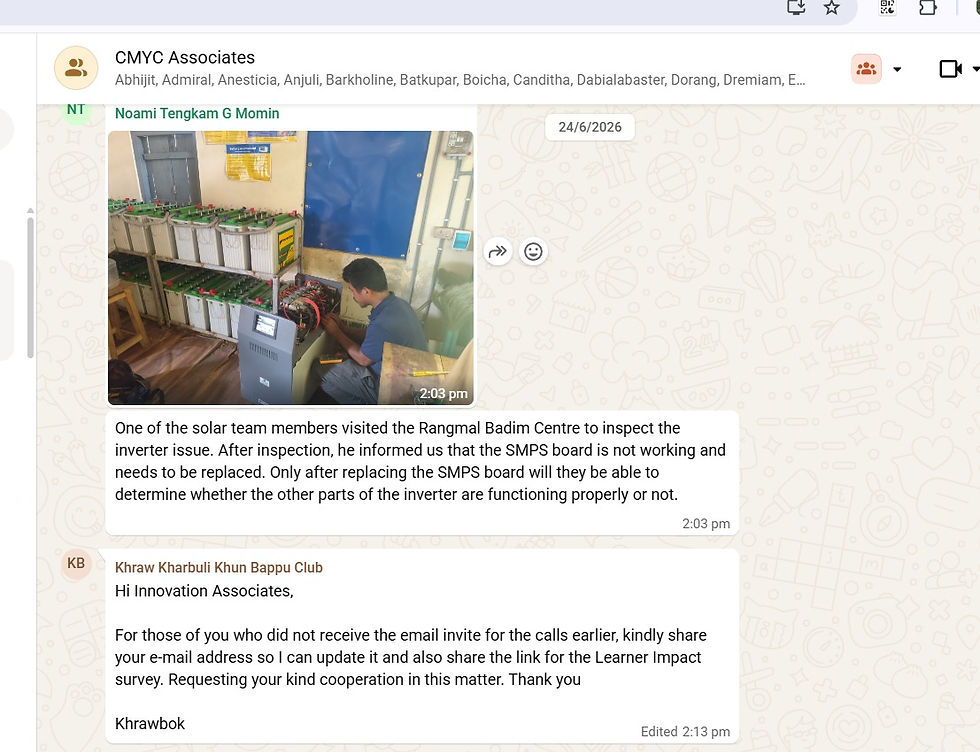
Project WhatsApp groups are often filled with conversations about operational challenges that field teams face every day. During implementation, immediate operational issues can easily overshadow quarterly impact targets (Figure 1).
Figure 1: Field team WhatsApp group reporting challenges they face
Practice teams, on the other hand, remain focused on developing methods, tools, playbooks, and policies. Ironically, this can also become a disadvantage. Practice teams must ensure that the artefacts they produce address real scaling challenges, contribute to state and national development priorities, and, most importantly, help programme teams achieve their targets.
Since 2024, Sauramandala Foundation has established five practice teams: Communication, Monitoring & Evaluation, Knowledge Management, Technology, and Fundraising. These teams often embed project managers within programme teams, with matrix supervision from both programme and practice leads.
Although programme and practice teams worked from the same offices in Bengaluru and Shillong — and regularly shared conversations over lunch — they did not always converge around a common operational picture.
Google Sheets proved insufficient for providing shared visibility across diverse partners, programme teams, and practice teams. In 2024, we began evaluating several enterprise resource planning (ERP) applications.
Introducing Project Management
After comparing several open-source and cloud-based project management platforms, we selected ERPNext, a free and open-source ERP built on the Frappe framework with MariaDB as its database backend. We initially implemented its Human Resources module to manage attendance and leave records.
In the first quarter of FY2026–27, the Knowledge Management team piloted ERPNext's Project Management module. Like most project management applications, it allows teams to create projects, milestones, and tasks (Figure 2).
Figure 2: Project management app pilot

The pilot produced mixed results. Team leads created projects and assigned tasks to task owners, but task owners updated only about 22 percent of their assigned tasks. During the quarterly review, the Knowledge Management team demonstrated both the application and the pilot findings to programme and practice teams.
The feedback was consistent. Most users found the default ERPNext interface too complex for day-to-day use and preferred a much simpler experience. Nevertheless, every programme and practice team expressed willingness to adopt a project management application if usability could be improved.
Over the following weeks, we developed a lightweight web application using Next.js and Tailwind CSS to evaluate user acceptance. The resulting application, PMHub, received overwhelmingly positive feedback from users (Figure 3).
Figure 3: Sauramandala PM Hub dashboard

Three Adoption Barriers
Technology alone could not solve the adoption challenge. Even after simplifying the interface, three practical barriers continued to emerge during the pilot.
1. Milestone or Task?
Project managers frequently struggled to decide whether an activity should be created as a milestone, a task group, a task, or a sub-task.
Should every activity become a task? When does a task become significant enough to be recorded as a milestone? Without simple decision rules, different project managers structured similar projects in completely different ways, making progress difficult to compare across teams.
2. Updates Without Insights
Most task owners updated only the task status, typically marking activities as Completed.During quarterly review meetings, however, programme leads wanted to understand why activities were delayed, what obstacles teams encountered, what decisions had been taken, and where support was required. A simple completion status provided very little insight for collective problem solving.
3. Another App to Update
Project teams were already sharing updates through WhatsApp groups, Google Chat conversations, meeting notes, and periodic reports. For many team members, the project management application felt like one more place where the same information had to be entered again.
Unless the application reduced reporting effort or replaced existing reporting channels, it risked becoming an additional administrative task rather than a tool that genuinely helped teams manage projects.
Rather than asking how do we make people update a project management application?, we found it more useful to ask how can project management become part of everyday work?
Our early pilot suggests that successful adoption depends less on features and more on workflow design. Teams need simple rules for structuring projects, updates that capture meaningful progress rather than only completion status, and reporting processes that minimise duplicate effort across multiple communication channels.
In the next phase of the pilot, we are experimenting with three approaches. First, we are developing practical guidelines to help project managers distinguish between milestones, task groups, and tasks. Second, we are redesigning task updates to capture brief narratives on achievements, challenges, risks, and support required instead of relying only on status changes. Finally, we are integrating PMHub with existing communication and reporting workflows so that teams update information once and reuse it across meetings, reports, and dashboards.
Beyond task tracking, our pilot also highlighted another potential role for a project management application. In organisations that work through multiple programme teams, practice teams, and external partners, it can provide a common view of project priorities, progress, and responsibilities. While technology alone cannot create alignment, a shared project workspace can make discussions more focused, reduce ambiguity, and help teams spend less time reconciling information from multiple sources.


Comments